Friday, November 3, 2017
Welcome back to our series of posts to help you get ready BEFORE your ducklings and goslings arrive!
HEATING & HEATING LAMPS
Ducklings and goslings are very vulnerable after first hatching and they require a source of heat for a period of time until they fully grow their adult feathers. Originally, this was mama duck's job, but as there is no mama duck in the hatchery world, you will have to find another source of heat.
HEATING & HEATING LAMPS
Ducklings and goslings are very vulnerable after first hatching and they require a source of heat for a period of time until they fully grow their adult feathers. Originally, this was mama duck's job, but as there is no mama duck in the hatchery world, you will have to find another source of heat.
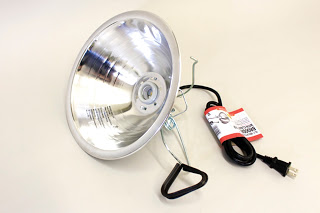
Heat lamps are the easiest and most common way of heating your brooder. Here on the farm we use and offer heat lamps with 150 watt bulbs. The hood is aluminum and has a ceramic setting. If you want to find your own bulb, we recommend finding a clear white bulb. You can use a red bulb (infrared), but those are used primarily for chicks to prevent cannibalism which is rarely seen in ducklings.
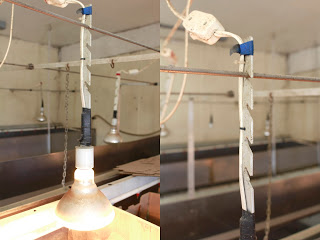
Heat lamps can be hung using chains from the ceiling or clamped onto a wall of the brooder. Temperature is controlled by lowering and raising the lamp. In the picture above, we have cut out notches in an aluminum flat bar and attached them to heat lamps to easily move them up and down.
We typically suggest starting at 90-95 degrees Fahrenheit under the heat lamp, but if you live in a warm area you may only need to turn on the lamp at night. We also suggest decreasing the temperature in the brooder by 5 degrees each week. It typically takes about a month or so for ducklings and goslings to start growing in their feathers. You can normally shut off supplemental heat within a couple of weeks when the outside temperature matches the temperature inside the brooder.
Make sure the heat source is off to the side so that they can leave the heat to cool off if they want. The important thing is to observe them. The birds should be moving freely around the brooder. If they start huddling under the light, you know they need more heat. If they stay away from the heat lamp, they are too hot and the heat lamp needs to be raised. If they start panting, then they are too warm and you can remove the heat lamp altogether.
Warning: Heat lamps can be a fire hazard if improperly handled.
BROODER THERMOMETER
In order to know the temperature within your brooder, we suggest putting a thermometer on the floor of the brooder so the temperature can be monitored.
ALERNATIVE SOURCES OF HEAT
We typically suggest starting at 90-95 degrees Fahrenheit under the heat lamp, but if you live in a warm area you may only need to turn on the lamp at night. We also suggest decreasing the temperature in the brooder by 5 degrees each week. It typically takes about a month or so for ducklings and goslings to start growing in their feathers. You can normally shut off supplemental heat within a couple of weeks when the outside temperature matches the temperature inside the brooder.
Make sure the heat source is off to the side so that they can leave the heat to cool off if they want. The important thing is to observe them. The birds should be moving freely around the brooder. If they start huddling under the light, you know they need more heat. If they stay away from the heat lamp, they are too hot and the heat lamp needs to be raised. If they start panting, then they are too warm and you can remove the heat lamp altogether.
Warning: Heat lamps can be a fire hazard if improperly handled.
BROODER THERMOMETER
In order to know the temperature within your brooder, we suggest putting a thermometer on the floor of the brooder so the temperature can be monitored.
ALERNATIVE SOURCES OF HEAT
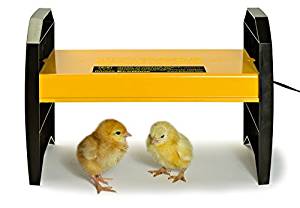
If you decide a heat lamp is not for you, you can try a Brinsea EcoGlow Brooder (shown above). The EcoGlow comes in two sizes, and Brinsea claims they are very safe as they use 12 volt power for heating.
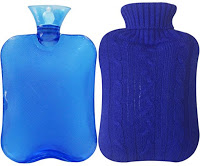
For those with no electricity, hot water bottles covered by towels are an effective alternative. Just be sure to switch out the water as the bottles cool, especially during the night. We encourage you to get creative. There are many different ways of setting up your heat source. What setup do you use? Tell us in the comments section below.
To read our post on the brooder and bedding, go to Getting Ready for Your Ducklings and Goslings: Brooder and Bedding.
To read our post on water and waterers, go to Getting Ready for Your Ducklings and Goslings: Water and Waterer.
To read our post on feed and feeders, go to Getting Ready for Your Ducklings and Goslings: Feed and Feeder.
To read about other items to consider, go to Getting Ready for Your Ducklings and Goslings: Other Things to Consider.
To read our post on the brooder and bedding, go to Getting Ready for Your Ducklings and Goslings: Brooder and Bedding.
To read our post on water and waterers, go to Getting Ready for Your Ducklings and Goslings: Water and Waterer.
To read our post on feed and feeders, go to Getting Ready for Your Ducklings and Goslings: Feed and Feeder.
To read about other items to consider, go to Getting Ready for Your Ducklings and Goslings: Other Things to Consider.