Wednesday, September 25, 2024
By Brigid McCrea, Ph.D., Alabama Cooperative Extension System
Not all eggs are clean when you collect them and bring them into the home. This can be especially true with duck eggs because ducks can be messier than chickens. So what is the value of washing duck eggs before storing them?
Unwashed Duck Eggs
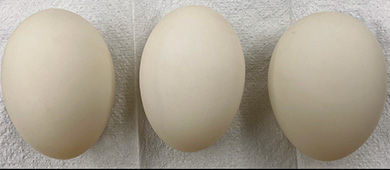
Let’s take a look at duck eggs that visually appear relatively clean (Figure 1) and duck eggs that appear very dirty (Figure 2). These two groups of unwashed eggs were subjected to whole egg rinses. A dozen duck eggs from each group was rinsed. A whole egg rinse allows microbes on the outside of the egg to be collected by the rinsing solution without cracking or destroying the shell. Next, the solution is plated onto two different types of media.
The two types of bacteria grown were based on what likes to grow on the outside of eggshells. Aerobes were grown, which are air-loving bacteria that can survive and multiply on many unclean food surfaces. Another group of bacteria was grown that is associated with fecal material in the form of coliforms and Escherichia coli (E. coli).
Washed Duck Eggs
What affect does washing the duck eggshell have on the number of bacteria present? A dozen eggs that appeared “clean” (Figure 3) and another dozen that appeared “dirty” (Figure 4) were washed. The washing step was simple in that the eggs were washed under running water for up to 30 seconds with a soapy sponge. These eggs were then allowed to dry on paper towels at room temperature for 30 minutes. Whole egg rinses were performed after the eggs were dried and the same two groups of bacteria were grown.
Not all eggs are clean when you collect them and bring them into the home. This can be especially true with duck eggs because ducks can be messier than chickens. So what is the value of washing duck eggs before storing them?
Unwashed Duck Eggs
Let’s take a look at duck eggs that visually appear relatively clean (Figure 1) and duck eggs that appear very dirty (Figure 2). These two groups of unwashed eggs were subjected to whole egg rinses. A dozen duck eggs from each group was rinsed. A whole egg rinse allows microbes on the outside of the egg to be collected by the rinsing solution without cracking or destroying the shell. Next, the solution is plated onto two different types of media.
The two types of bacteria grown were based on what likes to grow on the outside of eggshells. Aerobes were grown, which are air-loving bacteria that can survive and multiply on many unclean food surfaces. Another group of bacteria was grown that is associated with fecal material in the form of coliforms and Escherichia coli (E. coli).
Washed Duck Eggs
What affect does washing the duck eggshell have on the number of bacteria present? A dozen eggs that appeared “clean” (Figure 3) and another dozen that appeared “dirty” (Figure 4) were washed. The washing step was simple in that the eggs were washed under running water for up to 30 seconds with a soapy sponge. These eggs were then allowed to dry on paper towels at room temperature for 30 minutes. Whole egg rinses were performed after the eggs were dried and the same two groups of bacteria were grown.



Bacteriological Results
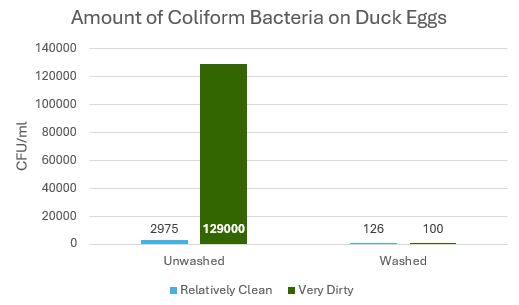
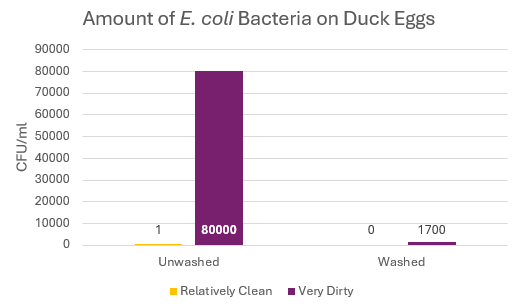
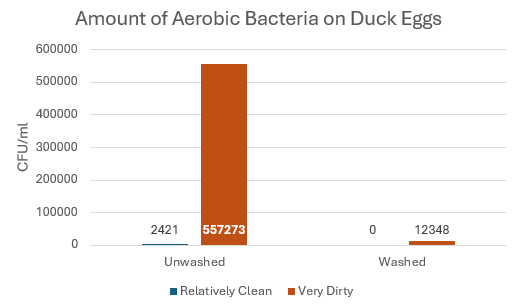
There was a large difference between the amount of bacteria on unwashed eggs if they were “clean” and “dirty.” On the eggs that were unwashed, there was over 43 times more coliform bacteria, 230 times more aerobic bacteria, and tens of thousands more E. coli on the very dirty eggs over that of the relatively clean eggs. For the most part, when washed eggs were tested for bacteria, the relatively clean eggs had fewer bacteria remaining on the surface than the very dirty eggs.
Regardless of whether eggs were relatively clean or if they very dirty, in all types of bacteria tested, the act of washing the eggs led to a reduction in bacteria numbers on the shell. For coliforms, the act of washing eggs led to a 24-fold reduction in bacteria for the relatively clean eggs, whereas for the very dirty eggs, the reduction in bacteria was over 1000-fold. For E. coli, the act of washing eggs led to a 47-fold reduction in bacteria for the very dirty eggs. For aerobic bacteria, the act of washing eggs led to a 45-fold reduction in bacteria for the very dirty eggs, whereas for the relatively clean eggs, the reduction in bacteria was over 2000-fold.
There was a large difference between the amount of bacteria on unwashed eggs if they were “clean” and “dirty.” On the eggs that were unwashed, there was over 43 times more coliform bacteria, 230 times more aerobic bacteria, and tens of thousands more E. coli on the very dirty eggs over that of the relatively clean eggs. For the most part, when washed eggs were tested for bacteria, the relatively clean eggs had fewer bacteria remaining on the surface than the very dirty eggs.
Regardless of whether eggs were relatively clean or if they very dirty, in all types of bacteria tested, the act of washing the eggs led to a reduction in bacteria numbers on the shell. For coliforms, the act of washing eggs led to a 24-fold reduction in bacteria for the relatively clean eggs, whereas for the very dirty eggs, the reduction in bacteria was over 1000-fold. For E. coli, the act of washing eggs led to a 47-fold reduction in bacteria for the very dirty eggs. For aerobic bacteria, the act of washing eggs led to a 45-fold reduction in bacteria for the very dirty eggs, whereas for the relatively clean eggs, the reduction in bacteria was over 2000-fold.
The effectiveness of washing duck eggs is evident in large decreases of bacteria present on the shell. It is recommended that eggs be washed to prevent bacteria known for causing spoilage and food safety concerns from migrating through the pores of the eggshell and into the edible interior of the egg. Additionally, when handling eggs that either appear relatively clean or very dirty, be aware that the surfaces and hands that touch those eggs will need to be thoroughly cleaned in order to avoid cross-contamination within the home kitchen.
Does the bacteria actually penetrate the eggshell and enter the egg?
Absolutely, they can! Most pores are partially covered by the bloom or cuticle, but that does not mean that bacteria are unable to pass through the pores and access the nutrients inside an egg. As the egg ages, the bloom dries and flakes off so that after several days there is less and less bloom remaining. Washing eggs before storing them in the refrigerator does two things, preserves the egg harvest and deters foodborne pathogen growth.
How long do unwashed eggs last outside the refrigerator verses inside the refrigerator?
For every day that an egg sits on the counter at room temperature, they age as much as if you had left them in the refrigerator for a week. Therefore, eggs will not remain as fresh as long on the counter, versus if they were refrigerated. The egg proteins degrade, release carbon dioxide, and lose moisture. This results in an egg that cannot perform as well in egg dishes compared to a fresh egg or an egg stored in the refrigerator.
Does the bacteria actually penetrate the eggshell and enter the egg?
Absolutely, they can! Most pores are partially covered by the bloom or cuticle, but that does not mean that bacteria are unable to pass through the pores and access the nutrients inside an egg. As the egg ages, the bloom dries and flakes off so that after several days there is less and less bloom remaining. Washing eggs before storing them in the refrigerator does two things, preserves the egg harvest and deters foodborne pathogen growth.
How long do unwashed eggs last outside the refrigerator verses inside the refrigerator?
For every day that an egg sits on the counter at room temperature, they age as much as if you had left them in the refrigerator for a week. Therefore, eggs will not remain as fresh as long on the counter, versus if they were refrigerated. The egg proteins degrade, release carbon dioxide, and lose moisture. This results in an egg that cannot perform as well in egg dishes compared to a fresh egg or an egg stored in the refrigerator.
Comments
When washed..must all eggs be refridgerated..
Linda p Giggey, Sunday, September 29, 2024
Washed eggs do not stay as fresh because you eliminate the protective bloom which PREVENTS bacteria from entering the egg. You can wash the egg just before cracking it open to cook.
Tami Berman, Tuesday, October 1, 2024
My question would not be what is on the outside of the egg but does the bacteria actually penetrate the eggshell and enter the egg? It has been my understanding (even from my medical doctor) that the blum on the egg dries preventing bacteria from entering the egg. So washing prior to use is just as effective. Not washing prior to storage protects the interior of the egg from being infected. We always wash our hands and tell others to do so after handling unwashed duck or any type of egg. Really - think about where they are expelled from.
K. Horn, Tuesday, October 1, 2024
I've read in many places that unwashed eggs - while yes, covered with bacteria - nevertheless store much longer than washed ones do because of the "cuticle" coating on the surface of the shell that keeps the bacteria from penetrating to the inside. I never wash my eggs.
Lorraine Ayre, Tuesday, October 1, 2024
Duck and or chicken eggs. How long do unwashed eggs last outside refrigerator? Verses inside refrigerator? Only wash eggs if they are very dirty. Ducks like to lay sometimes outside coop in mud. Chickens once in awhile like to bust an egg in nest. Wash and refrigerate and use first. I hear different things.
Squirrel, Friday, October 11, 2024
Do you have any guidance on the most efficient and effective way to wash duck eggs? We have used Egg Cleanser in a spray bottle up to this point, which still requires a lot of manual scrubbing to remove the debris and most of the staining to get them pearly white. We have recently tried soaking in an Egg Cleanser solution for 15 minutes, which seemed to reduce the amount of scrubbing a little, but it's still a lot. Would soaking longer be more effective without increasing risk of bacteria penetrating the shell? Are there other products or methods we should consider?
Rich Young, Tuesday, April 21, 2026