Monday, July 6, 2026
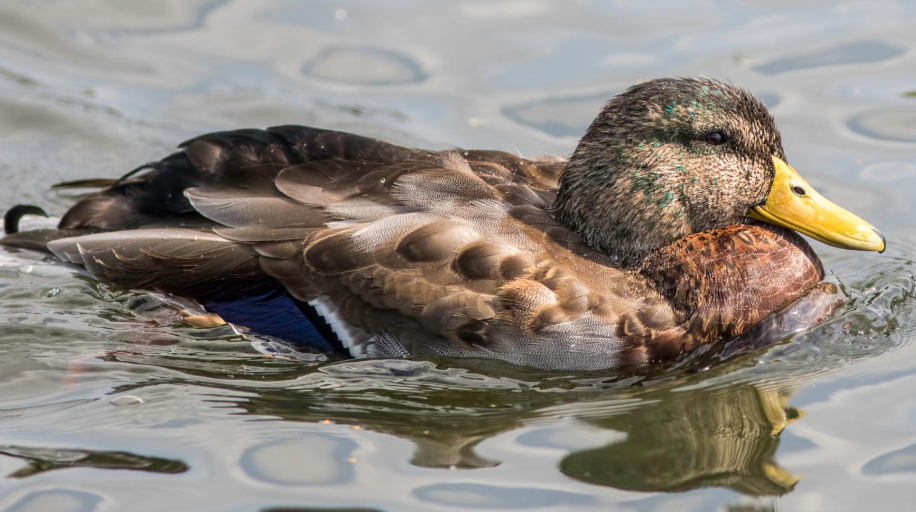
If you've ever looked at your flashy drake in late summer and thought, "Why does my drake duck suddenly look like a hen?", you're not losing your mind, and you're not imagining things. You're witnessing one of the more delightfully strange phenomena in the bird world: eclipse plumage.
For a few weeks every year, your handsome, iridescent drake trades his showy feathers for a drab, mottled, distinctly hen-like disguise. It's temporary, it's totally normal, and once you understand why it happens, you'll never look at your flock's late-summer scruffiness the same way again.
For a few weeks every year, your handsome, iridescent drake trades his showy feathers for a drab, mottled, distinctly hen-like disguise. It's temporary, it's totally normal, and once you understand why it happens, you'll never look at your flock's late-summer scruffiness the same way again.
What Exactly is Eclipse Plumage?
Most domestic duck breeds descend from wild mallards and have inherited aspects of the mallard's seasonal molt pattern.
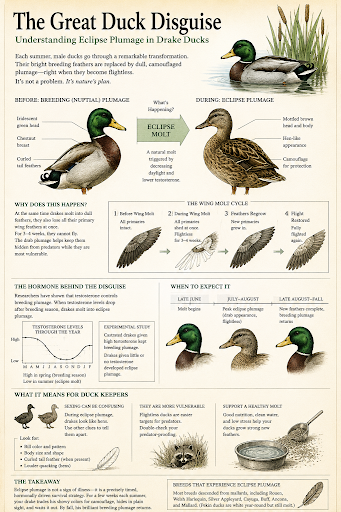
Both male and female mallards replace their feathers annually, but males undergo a particularly dramatic transformation after breeding season. A drake molts out of his flashy breeding, or nuptial, plumage and develops a much more subdued appearance known as eclipse plumage.
The iridescent green head, chestnut breast, and distinctive curled tail feathers we associate with a male mallard temporarily disappear beneath a coat of streaky, camouflage-brown feathers that can make him look remarkably similar to a hen.
And this isn't just a random summer wardrobe change. The timing of this transformation is closely tied to one of the most vulnerable periods in a duck's life.
The Real Reason: It's a Survival Strategy, Not a Fashion Choice
While drakes develop their duller eclipse feathers, they undergo their annual flight-feather molt. Unlike many birds, ducks replace their primary flight feathers all at once, temporarily leaving them unable to fly.
For a wild duck, being flightless for roughly three to four weeks is a pretty serious disadvantage. There's no flying away from a fox, hawk, or other predator.
And that's where the drab plumage comes in.
A bright green-headed drake sitting helplessly on the shoreline would be considerably more conspicuous than one dressed in mottled brown. During this vulnerable period, the subdued eclipse plumage provides camouflage that can help the bird blend into vegetation and other surroundings.
The timing is remarkable: the drake's colorful breeding plumage disappears around the same period that he loses his ability to fly, giving him a much less conspicuous appearance while he's temporarily grounded.
It's a pretty impressive example of how several seasonal changes in a wild bird's biology work together.
What Happens to the Hen?
There's an important difference between the molt of a male mallard and a female.
Hens do not develop an eclipse plumage. Their breeding, or nuptial, plumage is already relatively camouflaged, so they don't undergo the dramatic color change that males do. During their annual molt, hens replace all of their feathers, including their flight feathers, temporarily leaving them unable to fly.
Males also replace their feathers after the breeding season. The difference is that once a drake has regained his flight feathers, he replaces his drab eclipse body feathers with his more colorful nuptial plumage without having to replace his flight feathers again. Hens generally keep their breeding plumage until their next annual molt, while males keep their colorful nuptial plumage until the following summer, when they acquire their eclipse plumage.
A Clever Division of Vulnerability
This creates a fascinating seasonal rhythm.
The male and female don't necessarily become flightless at the same time. When one bird is going through its flight-feather molt, the other may still be capable of flight.
For a nesting pair, this means both adults aren't necessarily grounded at the same time. At least one member of the pair can remain capable of flight while the other is going through the vulnerable period of flight-feather replacement.
And there's another advantage to the timing: by the time fall migration arrives, both birds have fresh, new flight feathers. Those feathers will carry them through migration and, for many mallards, the winter season ahead.
It's a remarkable example of how the annual molt isn't just about replacing worn-out feathers. The timing of these changes is closely tied to breeding, camouflage, flight, and survival.
The Hormones Behind the Change
So what actually flips the switch?
The transition into eclipse plumage is hormonally regulated and closely connected to the seasonal reproductive cycle. Researchers have even experimented with testosterone in wild mallard drakes to investigate how hormones influence plumage.
Interestingly, the results weren't as simple as you might expect. In one classic experiment involving castrated wild mallard drakes, different doses of testosterone produced different plumage patterns. The birds receiving the highest testosterone treatment developed the most extensive eclipse coloration, while untreated control birds developed much more typical breeding plumage.
In other words, testosterone clearly plays an important role in regulating seasonal plumage, but the relationship isn't simply “more testosterone = brighter feathers.”
When Should You Expect Eclipse Plumage in Your Flock?
For wild mallards in the Northern Hemisphere, the eclipse molt generally occurs during the summer, often beginning around June and continuing into July and August.
Domestic ducks don't always follow the wild mallard calendar quite as neatly. Breeding history, genetics, location, daylight exposure, and the particular breed can all influence the timing and appearance of a molt.
So if your drake doesn't suddenly transform in June, or if his timing looks a little different from the mallards at your local pond, that doesn't necessarily mean anything is wrong.
Why This Matters for You as a Duck Keeper
- Sexing confusion is normal. If you're trying to tell drakes from hens by color alone during eclipse season, you may genuinely struggle, and that's the whole point! We see the eclipse molt in all our duck breeds except the Muscovy. Of course it is harder to see this occurring in breeds in which the drake and hen colors are similar or the same - such as the Pekin.
- Flightlessness means vulnerability. Even backyard ducks with clipped wings or low flight risk are going through the same simultaneous wing molt as their wild cousins. This is a good time to double-check predator-proofing, since your birds are physically less able to escape danger than usual.
- Tips to help differentiate males and females during the eclipse molt. Males are typically heavier with a thicker neck and larger head. You can tell by their voice as males have a deeper, raspier quack and females have the louder, typical QUACK. In some breeds you can differentiate by their bill color, but this is not true of all domestic duck breeds.
The Takeaway
Eclipse plumage isn't a fluke or a fashion downgrade, it's a precisely timed, hormonally driven survival adaptation that solves a very real problem: how does a duck stay safe when he can't fly? For a few weeks each summer, your drake essentially borrows a disguise, hides in plain sight, and waits it out. By fall, the disguise comes off, and your flashy boy is back.
Next time your drake looks a little drab in August, you'll know exactly what's happening and why it's actually pretty remarkable.