Thursday, October 1, 2026
Ever wonder why your ducks seem to lay like crazy during certain times of the year, then suddenly slow down? The answer has a lot to do with light, and the science behind it is pretty wild. From how ducks actually sense light to the way it triggers egg production, clutch cycles, and even those occasional “days off,” there’s a whole lot happening behind the scenes. If you’ve ever wondered what really controls your flock’s laying schedule, this one’s for you!
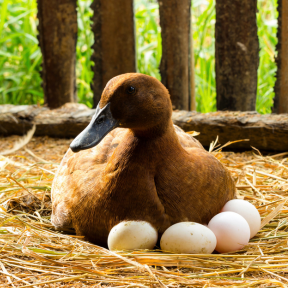
Let There Be Light!
Ducks don't just see light with their eyes—they actually feel it directly inside their brains.
A duck's skull is incredibly thin, allowing tiny particles of light (photons) to shine right through the bone. When this light enters the brain, it stimulates special light-sensing cells [extra-retinal photoreceptors]. The light hits two specific areas, triggering two very different behaviors:
-The Sleep Clock: When light hits the pineal gland in a region of the brain called the diencephalon it controls the duck's daily sleep cycle.
-The Egg Timer: When light hits the hypothalamus at the base of the brain, it triggers a chain reaction of chemicals [hormonal cascade] that tells the duck it is time to lay eggs.
Survival of the Fittest
Today’s ducks inherited these abilities from a massive, diverse group of ancient waterfowl [the ancestral gene pool]. However, not all ancient ducks reacted to light the same way. Through a process called natural selection, ducks with skulls that were too thick, or brains that reacted poorly to light, simply did not survive to raise babies.
Here is how natural selection weeded them out:
-The Sleep Mix-Up: Imagine an ancient duck whose pineal gland got confused. If the light made it sleep all day and hunt for food in the pitch-dark night, it would quickly starve to death or get eaten by predators.
-The Egg-Laying Mix-Up: Imagine another ancient duck whose hypothalamus ignored the increasing sunlight of spring. If it decided to wait and lay its eggs in the middle of winter, the freezing cold would wipe out all of its ducklings.
The Winners of Evolution
The only ducks that survived were the ones with the right biological setup. Because their brains perfectly understood the light, they stayed awake to find food during the day and knew to lay their eggs during the warm, sunny days of spring. This allowed them to raise healthy ducklings in the summer.
After thousands of generations, the ducks that made deadly mistakes were completely lost to natural selection. Today, we are left only with the highly adapted offspring of the ancient ducks who got it right.
Tricking Nature on the Farm
Farmers use this evolutionary biology to get more eggs. By turning on artificial lights, they trick the ducks into thinking it is a never-ending spring.
Because ducks are so sensitive to light, it only takes 10 to 20 lux of brightness (about 1 to 2 kerosene lanterns in a 5-foot circle) to keep them laying. In a modern barn, farmers usually provide 20 to 30 lux of light for 16 to 17 hours a day.
Here is how the body's communication system actually makes the egg:
1. Light passes through the skull and stimulates the hypothalamus of the brain.
2. The hypothalamus then signals the pituitary gland in the form of GnRH hormone, instructing it to activate the ovaries.
3. The pituitary writes two different letters with two conflicting instructions to the ovaries in the form of FSH and LH hormones.
4. FSH hormone goes to the ovary and stimulates the ovarian follicle development to produce a packet containing the ova/egg yolk.
5. At some point the duck ovary ends up with a fully matured follicle. At this time the LH hormone is sent from the pituitary gland to stimulate the release of that mature follicle.
6. Thus, the status quo of the ovary is that the FSH hormone stimulates it to continue developing follicles (ova). The objective is to help ducks lay more and more eggs.
7. When there is a mature follicle in the ovary that cannot be developed any further, there is a short periodic surge of LH hormone from the pituitary to break the follicular packet and release the ova, also known as ovulation.
8. FSH and LH hormones never surge into the ovary at the same time to prevent ducks from laying tiny eggs. Yet at the beginning of the laying cycle of young ducks you might observe a few tiny eggs as the pituitary gland of that duck is learning to adjust FSH and LH hormone levels for the first time.
9. Approximately 26-27 hours after the LH surge and ovulation, the ova completes its journey through the fallopian tube of duck. Within this time the yolk is surrounded by egg white, protected by a shell and laid as a duck egg.
It takes about 26 to 27 hours for that released yolk to travel down the fallopian tube and finally be laid.
The Daily Shift and Days Off
Because it takes 26-27 hours to build an egg, a duck's internal clock shifts forward by about 2 to 3 hours every single day.
Let’s look at a duck named Daniella who lives in a barn with a 16-hour light schedule (lights on from 6:00 AM to 10:00 PM). Here is what her week looks like:
There are big differences between the eggs Daniella lays at the start of her clutch versus the eggs at the end of her clutch.
Early Clutch Eggs: Because she has plenty of daylight, Daniella takes her time. She deposits more albumen (egg white), making the eggs bigger with thicker shells.
Late Clutch Eggs: Ovulating late in the afternoon means Daniella is rushing to finish the egg laying before the dark. These eggs spend less time in the fallopian, so they are smaller, have watery egg-whites, and thinner shells.
To be a good mother and make things fair, Daniella pumps extra steroids (like testosterone) into the smaller, late-clutch eggs. This hormonal boost helps the late-clutch, underweight ducklings grow fast so they can catch up with their early-clutch siblings.
Teamwork is the Dreamwork (Clutch Synchronization)
Now let's imagine you own a duck barn where Daniella lives with 99 other siblings. They all have a different day off from ovulation. Daniella takes a day off on Sunday, Stella is off on Monday, Stacy on Tuesday, Timisha on Wednesday…
You would expect all those ducks randomly taking a day off to complete their clutch. Thus, on average approximately 14 (100/7) ducks are on a pause at a given day. Therefore, every single day you should get 86 (100-14) eggs. But there is a small catch to it.
Daniella’s ancestor lived on a dangerous earth filled with lots of predators. So they decided to live in a flock, hence we know birds of a feather flock together. Ancestral ducks who flocked together had a better chance of living and raising their young, whereas those ducks who idolized being alone were often eaten out of the ancestral genepool. While flocking together, ducks developed a mechanism to recognise visual cues to detect the onset of spring; the best time to lay, marked by increasing day length and light intensity. However, young ducks laying for the first time often miss that cue until late spring, leaving them fewer summer days to raise their young.
To solve this problem of inexperience, several first time mama ducks started recognizing other visual cues, such as:
- watching other ducks making a nest
- finding a nest with an egg inside
- hearing a mating call from a drake etc.
Seeing a nest full of eggs often stimulates other ducks' pituitary to release the FSH hormone and recalibrate the LH surge making them start laying eggs. Thus, all the ancestral ducks in a flock synchronized their laying at the same time.
This synchronization also increased duckling survivability in the ancient world. If the entire flock lay at the same time, they will have all the ducklings hatching out within a single week in late spring/early summer. For a month in the summer, ancient swamps would have abundant ducklings that would overwhelm the appetite of predators. Then in late summer to early fall those ducklings took flight leaving the predator behind.
This also means that duck flocks with unsynchronized clutches will have babies hatching over an extended period, be vulnerable for longer and have a higher chance of being consumed by predators.
Being a descendant of that ancient flock Daniella and the rest of her siblings also synchronize their clutch and try to lay within quick succession of each other. On Monday morning when Daniella went into the nest to lay eggs, it stimulated Stella to squeeze out an LH surge and ovulate at 11:30 PM, just half an hour before the farmer turned off the barn light. Thus, from the next week onward Daniella and Stella have a synchronized clutch.
In larger flocks, instead of having 86 eggs every single day, farmers may have 90 eggs for 6 days and 1 day with around 75 eggs. This single day most of the ducks in a flock take a synchronized break, also known as clutch drop.
Expectation vs. Reality
In practice the duck has to mobilise fat, protein and vitamins from their liver, calcium from their bone, pass them through their blood to reach the ovary and fallopian tube then deposit them in eggs. It is an immense nutritional undertaking to lay eggs, so realistically you can expect around 80 eggs from every 100 ducks during peak egg production. After peak production, the number of eggs declines in response to physiological and nutritional stimuli and lack thereof.
Each Flock is Unique
Each flock handles the clutch drop differently. Some flocks have a steady clutch drop, where they consistently show poor egg production one day every week. Whereas in other flocks poor egg production day could be a different day on week one, then a different day on week two, then a different day on week three. When clutch drop moves into different days of the week it's considered clutch drift. This clutch drift typically slides by 1-3 days each week and it indicates your clutch takes less than seven days to complete. This drift is consistent, predictable and distinctly different from a broken clutch.
Beware of Broken Clutch
When there is a sudden unpredictable pattern in clutch completion observed in a flock with a record of steady clutch competition, it's considered a broken clutch. Broken clutch is normal and could be overlooked in young ducks as they start egg production. However, a broken clutch after peak production is often followed by a sharp decline in egg production. Broken clutch is a symptom initiated by underlying issues such as old age, off season, infection/parasites, sudden change in feed/feeding/lighting schedule, etc.
Comments
Thanks (exhaustive discourse) on duck egg laying….. even though I have chickens, now wish I had ducks!
Johann, Friday, October 9, 2026