Monday, December 22, 2025
Now that spring is approaching, it’s the perfect time to start preparing your nests! Whether you have just a pair of ducks or a flock of a thousand, creating the right nest environment is essential for the health and comfort of your female ducks or geese. If your nests aren’t suitable, your birds will take matters into their own wings and build nests elsewhere—often in inconvenient or unsafe locations that can put both the eggs and the adult birds at risk.
When designing a nest, size and comfort are key. The nest should be just large enough for a single bird to enter, turn around, and sit comfortably on her eggs. Avoid making nests too large, as it may encourage multiple birds to share one nest. Nest-sharing rarely works well; eggs can get broken, may cool down too much between birds, and if hatching is your goal, timing can be disrupted. Additionally, two females sharing a nest can lead to confusion over which chicks belong to which mother.
For practical sizing, a duck nest should measure approximately 12 inches by 14 inches. This provides enough room for a single duck to settle in comfortably while still keeping the eggs snug and protected. Goose nests should be slightly larger, around 18 inches by 18 inches, to accommodate their bigger size and larger clutch of eggs.
Beyond size, consider the nest’s location and materials. Place nests in a quiet, sheltered area that is safe from predators and protected from extreme weather. Line them with soft, clean bedding such as straw, hay, or wood shavings, and add a little extra for the female to rearrange and make the nest her own. Remember, ducks and geese often like to pull some of their own feathers to line the nest once they begin laying, so leaving them some room and privacy is essential.
By preparing nests that are appropriately sized, cozy, and secure, you give your ducks and geese the best chance for successful laying and hatching. A little planning now will save you frustration later and ensure that your birds feel safe, comfortable, and well-cared-for this breeding season.
When designing a nest, size and comfort are key. The nest should be just large enough for a single bird to enter, turn around, and sit comfortably on her eggs. Avoid making nests too large, as it may encourage multiple birds to share one nest. Nest-sharing rarely works well; eggs can get broken, may cool down too much between birds, and if hatching is your goal, timing can be disrupted. Additionally, two females sharing a nest can lead to confusion over which chicks belong to which mother.
For practical sizing, a duck nest should measure approximately 12 inches by 14 inches. This provides enough room for a single duck to settle in comfortably while still keeping the eggs snug and protected. Goose nests should be slightly larger, around 18 inches by 18 inches, to accommodate their bigger size and larger clutch of eggs.
Beyond size, consider the nest’s location and materials. Place nests in a quiet, sheltered area that is safe from predators and protected from extreme weather. Line them with soft, clean bedding such as straw, hay, or wood shavings, and add a little extra for the female to rearrange and make the nest her own. Remember, ducks and geese often like to pull some of their own feathers to line the nest once they begin laying, so leaving them some room and privacy is essential.
By preparing nests that are appropriately sized, cozy, and secure, you give your ducks and geese the best chance for successful laying and hatching. A little planning now will save you frustration later and ensure that your birds feel safe, comfortable, and well-cared-for this breeding season.
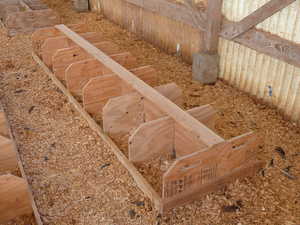
Our duck nest boxes (above). A 1"x4" along the top and both fronts. Use screws, not nails to hold together.
The next box rolled to show the bottom. (below)
The next box rolled to show the bottom. (below)

Notice how we have cut slots in the plywood so the nest walls slide into the nest back. No nails or screws are used to hold these parts together. It is just the 1x4s along the top and fronts that are screwed. Use at least 1/2" plywood.
Your birds may be very protected from predators but their instinct still tells them to hide their nest. For this reason you will want sides and a back on the nest.
Back it against a wall or fence or put it in a corner. If it is outside, it will definitely need a top for protection from the weather.
We have tried various styles of goose nests and so far the plastic barrel is the best. The advantages it has over the wood A frame nests described below are:
We have also used wooden A frame style nests for our geese. To keep the eggs cleaner, we have put burlap and plastic feed bags on the bottom of the nest. Unfortunately geese tend to shred it. If you have concrete or wood floors, make sure you have plenty of bedding in the nest. There is no need for a wooden bottom.
To keep the eggs cleaner, we have put burlap and plastic feed bags on the bottom of the nest. This is fine with ducks but geese tend to shred it.
If you have concrete or wood floors, make sure you have plenty of bedding in the nest. There is no need for a wooden bottom.
Your birds may be very protected from predators but their instinct still tells them to hide their nest. For this reason you will want sides and a back on the nest.
Back it against a wall or fence or put it in a corner. If it is outside, it will definitely need a top for protection from the weather.
We have tried various styles of goose nests and so far the plastic barrel is the best. The advantages it has over the wood A frame nests described below are:
- It is inexpensive. We found these used barrels for $8 each.
- They are easy to make. All you need is a drill and saber saw or sawzall.
- It is easier to collect eggs from the barrel.
- The bedding stays in the barrel.
- They are almost indestructible.
We have also used wooden A frame style nests for our geese. To keep the eggs cleaner, we have put burlap and plastic feed bags on the bottom of the nest. Unfortunately geese tend to shred it. If you have concrete or wood floors, make sure you have plenty of bedding in the nest. There is no need for a wooden bottom.
To keep the eggs cleaner, we have put burlap and plastic feed bags on the bottom of the nest. This is fine with ducks but geese tend to shred it.
If you have concrete or wood floors, make sure you have plenty of bedding in the nest. There is no need for a wooden bottom.

Note that we use blue barrels as that keeps it darker in the nest - which nesting birds prefer.

We drill some holes toward the top of the barrel to allow air circulation and we bolt two barrels together so they are less likely to tip.

An unbedded goose nest. It just needs a coat of paint.
We use a layer of straw followed with shavings. Notice it is built for two geese, entering from either end.
We use a layer of straw followed with shavings. Notice it is built for two geese, entering from either end.
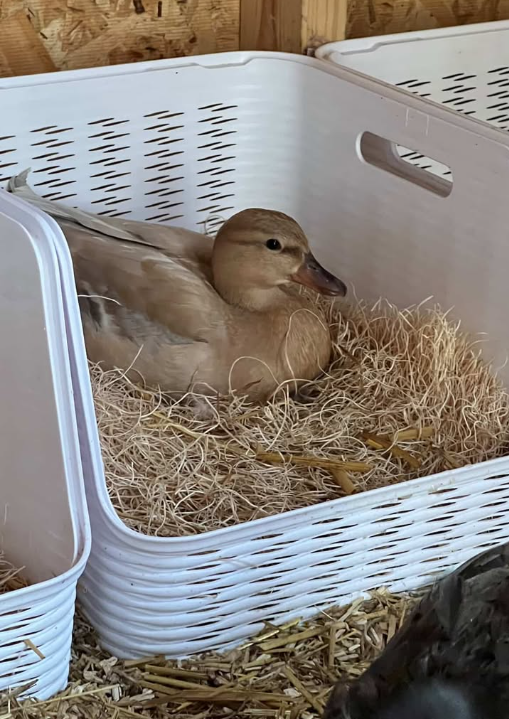
Our friend Krissy E., also known as Dunkin Ducks on social media, shared what she uses for her nesting boxes. (Pictured below) She let us know she loves using these plastic open front bins from Target as nesting boxes. They’re easy to wash & the bottoms won’t ever rot!